SGLang 分叉点缓存源码解析:从 43.8% 到 60.8% 的命中率是怎么来的
2026-09-19 对照 SGLang v0.5.20( 94602c9c2b)源码,覆盖 Python 核与 Rust 核两条实现路径数字口径:43.8% → 60.8%、平均 TTFT 1.57 s → 1.07 s 出自官方 v0.5.20 release notes,测试条件是 DeepSeek-V4-Flash + 共享 system prompt,属厂商自测口径。本文不重复测量,也不外推这个数字到其他模型或负载;它的边界在 §5.4 说明。
相关文章:SGLang UnifiedRadixTree:一棵树,四种注意力——那篇讲统一树如何把四种注意力收进一棵树,结尾 §6.4 提到「树核心用 Rust 重写」的路线;本文是这条路线上的一个具体落地。
一、混合注意力让前缀缓存有了两个边界
推理服务里,大多数请求共享同一段开头:system prompt、角色设定、挂载的长文档。前缀缓存的价值全在这上面——共享开头只要算过一次,后续请求复用它的 KV,跳过这段 prefill,首字延迟(TTFT)随之下降。反过来,命中每缺一段,就有一段本可跳过的 prefill 被重算一遍。命中率是直接换算成延迟和成本的指标,标题里那 17 个百分点的落差,量的就是这个此前没人处理的重算。
在 DeepSeek-V4 这类混合注意力模型里,一部分注意力层是滑动窗口注意力(SWA):每个 token 只对最近 W 个 token 做注意力,窗口之外的 KV 不再参与任何后续计算。这类层在 KV pool 里单独建池、单独回收,树上的索引也单独一份。一棵基数树按 token 组织索引、请求带着 token 序列去匹配的旧语义,从这里开始要同时回答两个问题:Full 层能复用到哪,SWA 层能复用到哪。这就是标题里「两个边界」的来源。
1.1 同一个节点上,两个独立的数
统一树(UnifiedRadixTree)把每个缓存状态做成一个组件,节点上的状态按组件类型分开存放。SWA 组件在这个模型里的位置,它自己的类文档写得很清楚(unified_cache/components/swa.py:60-68):
Each SWA node stores translated SWA pool indices as its component value, independent of the full attention indices on the same tree node. When SWA data is evicted from an internal node the node is tombstoned — its SWA component value becomes
Nonewhile the full attention value stays intact.
一个树节点因此可以同时持有两种值:Full 注意力的 KV 索引,和 SWA 的池索引。两者的生命周期互相独立:Full 的值还在,SWA 的值可以已经是 None(代码里叫 tombstone,墓碑)。注意这里说的是生命周期——两种索引在同一时刻成对分配,SWA 索引随时可以从 Full 索引查出来,直到 SWA slot 被回收为止,这一点在 §3.3 展开。
这意味着「这个前缀命中了多长」第一次有了两个答案。
1.2 SWA 只保留一个窗口
第二个答案是短的那个,原因在池的回收策略。SWA 的 KV 池是一个滚动窗口:只要序列往前推进,窗口外的 KV 对后续计算就再没有用处,留着只是占显存。
回收动作在 mem_cache/common.py:55-100,阈值定在 common.py:86:
# Radix cache: keep max(window, page). The trailing floor page-aligns the
# frontier, and subtracting at least one page keeps it below the insert
# boundary (page_floor(seq_len)) so the last leaf is never all-tombstone.
# No extra page margin is needed.
evict_threshold = pre_len - max(sliding_window_size, page_size)
pre_len 是当前序列长度。比「最后一个窗口」更早的 SWA KV 一律释放。这个回收在解码期间周期性发生,间隔由 SGLANG_SWA_EVICTION_INTERVAL 控制(environ.py:666,默认 128 个 decode batch)。
于是树节点上就出现了墓碑:节点还在拓扑里、Full 的值还在,但 SWA 的值已经变成 None。
1.3 缺口就是这么来的
把前面两件事叠起来,会得到这样一个状态:
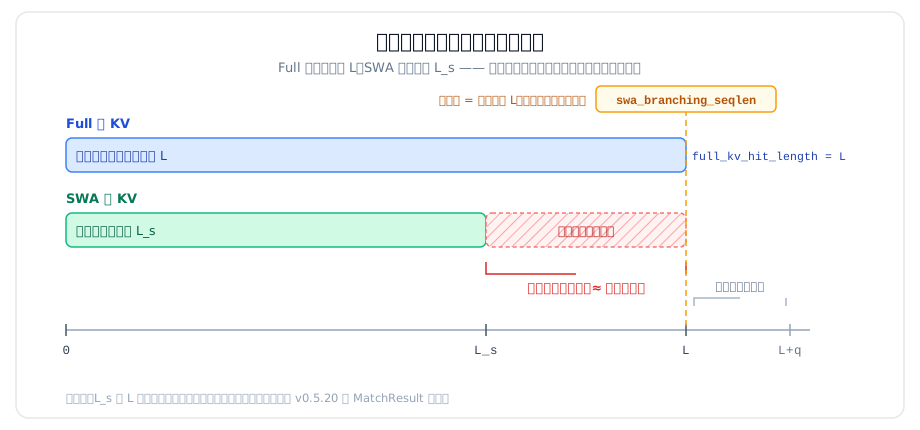
图 1|两个可复用边界:Full 的命中延伸到 L,SWA 只覆盖到 L_s,两者的差就是每个分叉请求都要重算的部分;分叉点是页对齐后的 L,越过边界时才存在。
Full 组件能命中的前缀长度(代码里叫 full_kv_hit_length)可以一直延伸到 L,而匹配的实际落点 L_s 由 SWA 决定——它只有一个窗口。两者之差,就是前向必须重新计算的那一段。
这个缺口是两种缓存语义差异的自然结果:Full 的 KV 只依赖它自己之前的所有 token,永久有效;SWA 的 KV 只在窗口内有意义。问题在于,一个请求从共享前缀上分叉出去之后,分叉点附近那个 SWA 窗口本来是算过的,却被当作出窗数据释放掉了,下一个在同一个点分叉的请求只能从头再算一遍。
在 #34565 之前,这个缺口没有任何机制去补:每个分叉请求都要重算那一个窗口,哪怕它的前一个请求刚刚算过一模一样的 token。负载里分叉请求有多少,这笔重算就付多少次。官方口径下 43.8% 到 60.8% 的提升,落的就是这类重算。
二、分叉点:把缺口算准(匹配侧)
代码里解决这件事的第一步,是把缺口的位置精确地表示出来。这个位置叫分叉点,在 MatchResult 里是一个整数 swa_branching_seqlen。
2.1 定义
定义写在 base_prefix_cache.py:238-240:
swa_branching_seqlen: The SWA radix cache branching point, which is the longest page-aligned position that could’ve been cache hit if there exists an SWA window.
「假如有 SWA 窗口的话,本可以被命中的最长页对齐位置」。这句话反过来说就是:分叉点标记的是 SWA 的缺席。它是 None 的时候,说明 SWA 已经覆盖了 Full 能命中的全部范围,没有缺口。
2.2 计算
真正的计算在 unified_cache/components/swa.py:344-386 的 finalize_match_result_in_tree_core,它是匹配流程的最后一步:
ct = self.component_type
swa_boundary_len = len(result.device_indices) + result.host_hit_length

# Full KV may extend beyond the latest reusable SWA window. The branching
# point is the last page-aligned position within the Full-KV hit that lies
# beyond the current SWA boundary.
aligned_seqlen = (
    result.full_kv_hit_length // self.tree_core.page_size
) * self.tree_core.page_size
branching_seqlen = aligned_seqlen if aligned_seqlen > swa_boundary_len else None
读法很直接:把 full_kv_hit_length 向下对齐到页边界,得到一个候选位置;只有它严格超过实际到达的边界时,才成为分叉点。
Rust 核里是同一件事,注释写得更短(rust/sglang-radix-tree/src/components/swa.rs:427-433):
// Branch at the last page-aligned Full-KV position past the SWA boundary.
let page_aligned_full_hit_len =
    result.full_kv_hit_length / tree_core.page_size * tree_core.page_size;
result.swa_branching_seqlen =
    (page_aligned_full_hit_len > swa_boundary_len).then_some(page_aligned_full_hit_len);
2.3 为什么必须页对齐
页对齐不是保守估计,是硬约束。SWA 池按页分配,一个页要么整页有效要么整页无效;分叉点如果落在页中间,插入时就会出现「半个页在窗口内、半个页在窗口外」的状态,无法用一个页索引表达。
这个约束在插入侧有断言兜底(swa.py:410-412):
assert swa_evicted_seqlen % self.tree_core.page_size == 0, (
    f"{self.component_type}: swa_evicted_seqlen must be page-aligned, {swa_evicted_seqlen=}"
)
向下对齐而不是向上,是因为向上会越过 Full 能命中的范围,那边没有 KV 可以复用。
2.4 从匹配结果到插入回执
分叉点算出来之后,要穿过四个层次才能变成实际的缓存写入。这条链在代码里是可以完整追下来的:
| 位置 | 字段 | 含义 |
|---|---|---|
base_prefix_cache.py:256 |
MatchResult.swa_branching_seqlen |
匹配结果里带出来 |
managers/schedule_policy.py:212 |
req.swa_branching_seqlen |
挂到请求上 |
base_prefix_cache.py:90 |
InsertParams.swa_branching_seqlen |
传给插入流程 |
base_prefix_cache.py:112 |
InsertResult.swa_branch_inserted |
插入回执(布尔) |
注意第三段的字段名和第一段相同、但语义不同:匹配侧它是「缺口在哪」,插入侧它是「把窗口钉在哪」。同一个整数,从观察变成了指令。
三、把窗口钉在分叉点上(插入侧)
匹配侧只负责发现缺口。真正提高命中率的动作发生在请求把自己的 KV 写回树的时候。
3.1 改写插入长度
请求前向结束、准备把 KV 插入树时,SWA 组件会拿到一次改写插入长度的机会(swa.py:925-952):
def prepare_for_caching_req(
    self,
    req: Req,
    insert_params: InsertParams,
    token_ids_len: int,
    is_finished: bool,
) -> Optional[int]:
    # Unfinished requests can already have an SWA-evicted prefix; preserve
    # that boundary so insertion creates a tombstone instead of live SWA KV.
    insert_params.swa_evicted_seqlen = req.kv.swa_evicted_seqlen

    # A recurrent checkpoint must stay attached to its exact token prefix.
    # Let MambaComponent select the insertion length for hybrid caches.
    if self.cache.is_mamba_enabled:
        return None

    branching_seqlen = req.swa_branching_seqlen
    if branching_seqlen is None or branching_seqlen <= req.kv.cache_protected_len:
        return None

    # An EAGLE key with N bigrams spans N + 1 raw tokens.
    effective_cache_len = branching_seqlen + int(self.tree_core.is_eagle)
    if effective_cache_len > token_ids_len:
        return None

    # Record the logical SWA branch boundary for insertion.
    insert_params.swa_branching_seqlen = branching_seqlen
    return effective_cache_len
返回的 effective_cache_len 就是这次插入要覆盖的长度。不去改写的话,插入只覆盖到「已保护长度」为止;改写之后,插入边界被推到分叉点,正好把以分叉点结尾的那个 SWA 窗口也写进树里。
三个提前返回各自有理由:
- 分叉点不存在,或者已经落在已保护范围之内(
branching_seqlen is None or branching_seqlen <= cache_protected_len),没有新的东西要写。 - 请求自己的 token 不够长(
effective_cache_len > token_ids_len),分叉点超出了这次前向的范围,没有数据可写。这里比较的是 EAGLE 修正之后的长度。 - 那处
+1来自 EAGLE 的缓存键:投机解码下键是 bigram,N 个 bigram 跨越 N+1 个原始 token,所以要向上修正一位。
3.2 写入时的三种节点
真正落到树上的是 commit_insert_component_data(swa.py:509-544)。它先记回执:
branching_seqlen = params.swa_branching_seqlen
if branching_seqlen is not None:
    assert params.key is not None
    result.swa_branch_inserted = len(params.key) >= branching_seqlen
然后按节点相对 SWA 窗口的位置分三类处理(swa.py:525-535):
node_start = result.prefix_len
node_end = node_start + len(node.key)
split_pos = params.swa_evicted_seqlen - node_start
if split_pos >= len(node.key):
    # Entire leaf is outside the SWA window — left as a tombstone.
    return
result.record_adopted_range(
    self.component_type,
    max(node_start, params.swa_evicted_seqlen),
    node_end,
)
窗口外的整节点留作墓碑,窗口内的节点登记为「已采纳」,跨越边界的节点被切开(swa.py:536-540):外侧是墓碑,内侧拿 SWA 值。墓碑不是冗余状态:它保留了节点的拓扑位置,让后续匹配能走到这里再判定,不会在中途断开。
上面这段是新叶子的处理路径。如果插入命中的是一个已经存在的节点(is_new_leaf 为假),走的是另一个函数 update_component_on_insert_overlap(swa.py:388-466),它按 swa_evicted_seqlen 把节点分成「整段在窗口内」「跨越边界」「整段在窗口外」三支处理,第三支直接不消费这段数据。两条路径的判定标准一致,只是节点是新建还是复用。
3.3 SWA 的值从哪来
节点上的 SWA 值由 SWARebuild 这个动作写入,它做的是把同一个节点的 Full 值翻译成 SWA 索引(swa.py:1501-1507):
if isinstance(action, SWARebuild):
    # Translate the node's source full value to SWA and store it on the node.
    swa_value = self._translate_full_to_swa(action.source_value)
    self.tree_core.set_component_device_value(
        action.node_id, self.component_type, swa_value
    )
    return
翻译本身是一次查表(swa.py:221-224),查的是分配器维护的 full→SWA 映射:
def _translate_full_to_swa(self, full_indices: torch.Tensor) -> torch.Tensor:
    return self.cache.token_to_kv_pool_allocator.translate_loc_from_full_to_swa(
        full_indices
    )
这个映射在分配时就建立了。SWA 池的 alloc 一次分配两块空间,并登记两者的对应关系(allocator/swa.py:219-232):
alloc_full_indices = self.full_attn_allocator.alloc(need_size)
alloc_swa_indices = self.swa_attn_allocator.alloc(need_size)
assert alloc_full_indices is not None
assert alloc_swa_indices is not None

self.set_full_to_swa_mapping(alloc_full_indices, alloc_swa_indices)
return alloc_full_indices
于是分叉点缓存能省下的是本就已经算好、而且 slot 还活着的那一段 SWA KV。机制做的事是在回收之前把它的索引记到树节点上。swa_evicted_seqlen 标记的正是「从哪个位置起 slot 还活着」,SWARebuild 只对这个位置之后的部分生效。
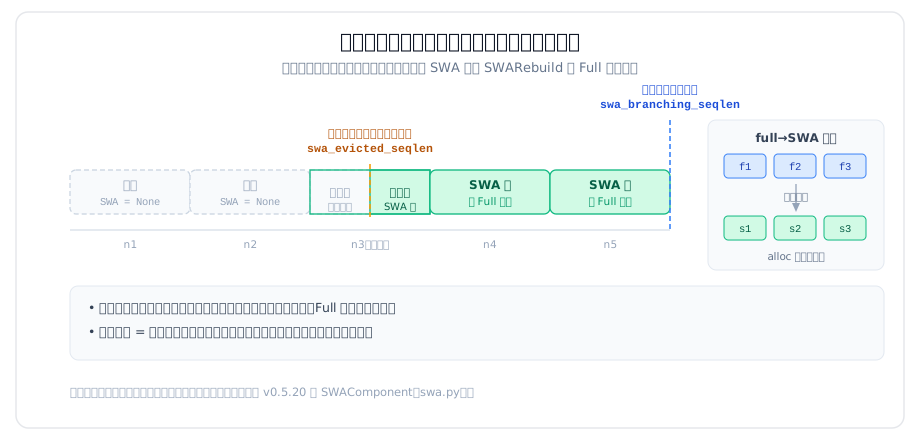
图 2|插入时的两条边界:swa_evicted_seqlen 左侧留墓碑保拓扑,两条边界之间的存活窗口由 SWARebuild 从 Full 翻译而来,插入边界推到分叉点。右侧的翻译查表即本节的 full→SWA 映射。
3.4 两条调用路径与释放时机
释放出窗 slot 的时机在两条调用路径上并不相同,这一点容易读错。
请求正常结束走 cache_finished_req,顺序是「prepare → insert → cleanup」,释放发生在插入之后的 cleanup_after_caching_req 里(swa.py:973-991):
if insert_result is not None and insert_result.swa_branch_inserted:
    req.swa_branching_seqlen = None

# Free unused SWA slots after inserting the branch.
if (
    not is_finished
    and insert_result is not None
    and insert_result.swa_branch_inserted
    and envs.SGLANG_OPT_UNIFIED_CACHE_FREE_OUT_OF_WINDOW_SLOTS.get()
):
    forward_key_len = len(req.get_fill_ids()) - int(self.tree_core.is_eagle)
    self._free_out_of_window_slots(req, forward_key_len - 1)
chunked prefill 中途的 cache_unfinished_req 则相反,释放发生在插入之前(unified_radix_cache.py:1141-1148),而且这一步同时决定了插入停在哪里:
if envs.SGLANG_OPT_UNIFIED_CACHE_FREE_OUT_OF_WINDOW_SLOTS.get():
    # The frontier lands a page below page_floor(pre_len + 1), which has to
    # be where the insert stops, or the leaf it creates keeps less than a
    # sliding window of live SWA and the match after the insert rejects it.
    # The insert stops at page_floor(len(radix_key)), and a bigram key is
    # one shorter than the tokens it spans, so measure the key.
    for comp in self._components_tuple:
        comp.free_out_of_window_slots(req, len(radix_key) - 1, insert_params)
先释放再插入不是笔误。释放函数除了回收 slot,还会把回收进度写进 insert_params.swa_evicted_seqlen(swa.py:967-971),而插入正是靠这个值来决定哪些节点留作墓碑、哪些节点能拿 SWA 值。上游注释说明了这条约束的代价:如果插入停下的位置让新叶子剩下的存活 SWA 不足一个滑窗,插入之后紧接着的那次匹配就会拒绝它。
两条路径里的释放都受同一个开关门控(SGLANG_OPT_UNIFIED_CACHE_FREE_OUT_OF_WINDOW_SLOTS,environ.py:664,默认开启)。这个开关不是本次引入的,分叉点缓存只是开始使用它。
四、复用闭环与收益来源
4.1 下一次匹配
机制的闭环在匹配侧就能看到:窗口写进树之后,下一个在同一个点分叉的请求再做匹配,swa_boundary_len 已经覆盖了分叉点,于是 aligned_seqlen > swa_boundary_len 不成立,swa_branching_seqlen 变成 None,插入侧的三段逻辑全部提前返回——没有缺口需要补了。
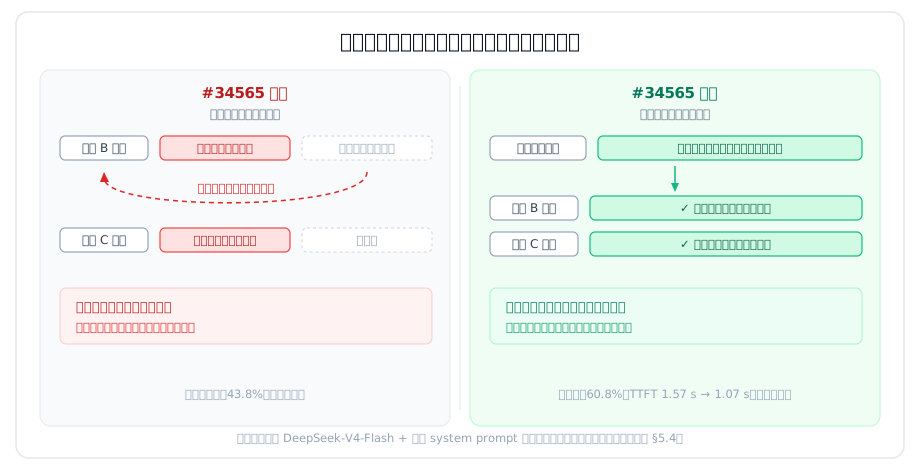
图 3|修复前后的对比:缺口从「每个分叉请求重算一遍再释放」变成「一次物化、后续复用」。图中数字为官方自测口径,边界见 §5.4。
测试把这个闭环写成了显式断言(test/registered/unit/mem_cache/test_unified_radix_cache_unittest.py:6506-6524):
result = cache.match_prefix(MatchPrefixParams(key=RadixKey(array("q", tokens))))

self.assertEqual(result.full_kv_hit_length, len(tokens))
self.assertEqual(result.swa_branching_seqlen, len(tokens))
self.assertEqual(result.swa_branching_seqlen % self.cfg.page_size, 0)

# Simulate forward producing fresh SWA KV at the branching point.
self._insert(
    cache,
    allocator,
    req_to_token_pool,
    tokens[: result.swa_branching_seqlen],
)

rematch = cache.match_prefix(
    MatchPrefixParams(key=RadixKey(array("q", tokens)))
)
self.assertEqual(len(rematch.device_indices), result.swa_branching_seqlen)
self.assertIsNone(rematch.swa_branching_seqlen)
最后两行是这套机制的落点:复用的设备 KV 长度增长到分叉点,分叉点本身消失。
测试里那句注释 # Simulate forward producing fresh SWA KV at the branching point. 说明了这些 SWA KV 的来源:请求自己的前向已经把 Full 和 SWA 两块都算出来了(§3.3 的 full→SWA 映射就是这一次前向留下的)。机制做的事,是在它们被回收之前把索引记到树节点上。
4.2 收益从哪里来
按上面的机制,一个请求能省下的量是有限的:不是整段共享前缀,而是分叉点结尾处那一个 SWA 窗口。树里保存的也只有这一个窗口,写入时窗口外的节点一律留作墓碑(§3.2)。
官方选的场景是共享 system prompt,这类负载把收益放到了最大。所有请求在同一位分叉,一个持久化的窗口能服务后续每一个请求;系统提示词很长而各请求自己的追问很短,省下的窗口在单请求总输入里占比不小;请求数又足够多,首次到达分叉点的那个请求(它匹配时树里还没有这个窗口,仍要重算)付出的成本会被后续请求摊薄。测试模型本身也对得上:DeepSeek-V4-Flash 在统一树里就是 FULL+SWA 的组合(lmsys 架构博客),恰好落在这个机制覆盖的形态上。
反过来,如果请求之间几乎不共享前缀,或者共享部分的长度只有一个窗口左右(那时分叉点本来就是 None),这个机制不起作用。
这里给的是机制层面的说明,不是对 43.8% 和 60.8% 的验算。官方没有给出窗口大小、共享前缀长度和请求数,那些数字无法反推(§5.4)。
4.3 双后端夹具
#34565 给测试加了一个细节:Python 核和 Rust 核共享同一套夹具,测试在两个后端上跑同样的断言。这个设计在 #37584(Rust 移植)之后才真正生效:移植之前,swa_branching_seqlen 相关的用例在 Rust 后端下是跳过的,跳过门禁里写着:
-    def _skip_swa_branching_on_rust(self) -> None:
-        # TODO(alphabetc1): drop this gate once #37584 ports SWA branching-point
-        # caching to the Rust tree core.
-        if _selected_tree_core_test_backend() == "rust":
-            self.skipTest("SWA branching-point caching is Python-core only")
移植提交删掉了这个门禁。这行 TODO 是判断两个提交关系的直接证据:Python 侧先有实现,Rust 侧后补对齐。
五、机制之外:三处边界与一处口径
5.1 mamba 混合时的早退
prepare_for_caching_req 里有一行看起来无关的提前返回(swa.py:936-939):
# A recurrent checkpoint must stay attached to its exact token prefix.
# Let MambaComponent select the insertion length for hybrid caches.
if self.cache.is_mamba_enabled:
    return None
Full + SWA + Mamba 三种状态共存的模型(Inkling 是这种组合)里,SWA 组件放弃改写插入长度的权力,交给 Mamba 组件决定。原因是 Mamba 的循环状态是一个「整段前缀的摘要」,它必须挂在确切的那一个 token 前缀上。如果 SWA 把插入边界推到分叉点,Mamba 检查点就会落到一个错误的位置上。
5.2 HiCache 的增量备份
分叉点窗口写进设备之后,还要考虑它会不会被备份到主机侧。_collect_unbacked_swa_nodes(swa.py:92-131)沿父链回溯一个滑窗,收集「在设备上、主机上没有」的节点(Rust 侧的对应实现是 collect_unbacked_swa_nodes_in_window_):
while (
    cur is not self.tree_core.root_node and covered < self.sliding_window_size
):
    if cur.write_through_pending_id is not None:
        break
    cd = cur.component_data[ct]
    value = cd.value if cd.value is not None else cd.host_value
    if value is None:
        break
    covered += len(value)
    if cd.value is not None and cd.host_value is None:
        unbacked.append(cur)
    cur = cur.parent
write_through_pending_id 的检查是关键:遇到已经挂起写穿的节点就停,保证两个 ack 不会认领同一个节点(Rust 侧注释:that ack owns everything above it, so two acks can never claim the same node)。
5.3 Rust 核默认是关的
#37584 的标题是「Port SWA Branching-Point Caching to the Rust TreeCore」——「Port」是把已有实现搬到另一个核,不是一次优化。当前默认后端仍然指向 Python 核(environ.py:672):
SGLANG_UNIFIED_RADIX_TREE_CORE_BACKEND = EnvStr("python")
也就是说,默认配置下走的是 Python 路径,Rust 核是可选后端。
而且这次移植也不是纯机械搬移,顺带带了三处改动:
prepare_for_caching_req里新增了 §5.1 那段 mamba 早退,父提交里没有is_mamba_enabled这个判断。host_memory_mode == "buffer_only"的下沉:从直接读self.cache改成读核上的标志位is_host_memory_buffer_only(swa.py:102),因为 Rust 核够不到 Python 侧的cache对象。- Rust 侧补齐了
TreeComponent::needs_incremental_backup的实现:这个 trait 方法在父提交里已存在但默认返回false,SwaComponent没有实现。
有一件事需要如实说明:移植提交的 message 只有标题、没有正文,仓库里也没有对应的 PR 描述文本。所以「Rust 化是为了性能」这个说法在当前证据下没有依据;从结构性证据(双后端对齐、默认关闭)看,它是一次功能对齐。本文不猜测它的动机。
5.4 数字的口径
回到标题里的数字。官方 release notes 的原文是:
Branching-point caching for the SWA component keeps the sliding-window state at the point where requests fork from a shared prefix, so branches reuse it instead of recomputing. On DeepSeek-V4-Flash with a shared system prompt, token hit rate rises from 43.8% to 60.8% and mean TTFT falls from 1.57 s to 1.07 s (#34565).
三件事需要标明:
- 这是厂商自测。SGLang 官方在 release notes 里给出的结果,不是独立第三方测量。本次核对在 v0.5.20 的代码树(
python/、rust/、docs/)里搜过这两个数字,没有任何一处是作为命中率记录的(子串匹配到的都是 cookbook 里的443.84 ms、143.89 ms这类无关数字)——这两个数字只存在于 release notes 与 PR 页面。 - 条件是具体的:DeepSeek-V4-Flash、共享 system prompt 的负载形态。
- release notes 里没有给出窗口大小、共享前缀长度、请求数这些能复算的中间量,所以无法从 43.8% 和 60.8% 反推测试配置。
另外,release notes 里「branches reuse it instead of recomputing」这句话在源码里没有对应的注释原文。「分叉点状态被反复重算」是从 full_kv_hit_length 与 swa_boundary_len 的差值推出的,属于对机制的合理描述,但不是代码里的原话。本文 §1.3 的图示同理,是解释性重构。
六、小结
分叉点缓存补的是混合注意力引入的一个结构性缺口:
- 统一树上,同一个节点的 Full 值和 SWA 值各自回收、生命周期互相独立,前缀命中长度因此有两个答案。
- SWA 池只保留一个窗口,更早的 KV 一律释放,于是 Full 的命中可以越过 SWA 的可复用边界。
- 缺口的位置被精确表示为
swa_branching_seqlen:最长的、页对齐的、越过 SWA 边界的 Full 命中位置。 - 插入时把边界推到分叉点,让以它结尾的那个 SWA 窗口落进树里;下一个在同一位置分叉的请求命中它,缺口消失。
- 能省下的是一个窗口的量,所以「长共享前缀 + 短分叉后缀」的负载收益最大。
它接在统一树这条线上:#34565 在 Python 核里实现,#37584 对齐到 Rust 核,而 Rust 核目前仍是可选后端。这两步都发生在 v0.5.20 里。
源文件索引
| 文件 | 关键内容 | 引用点 |
|---|---|---|
python/sglang/srt/mem_cache/base_prefix_cache.py |
MatchResult / InsertParams / InsertResult 中分叉点字段的定义 |
:90, :112, :238-240, :256 |
python/sglang/srt/mem_cache/unified_cache/components/swa.py |
SWA 组件:匹配终局计算、插入改写、重叠分支处理、写回、SWA 值翻译与重建、清理、HiCache 备份采集 | :60-68, :92-131, :102, :221-224, :344-386, :388-466, :410-412, :509-544, :925-952, :967-971, :973-991, :1501-1507 |
python/sglang/srt/mem_cache/unified_radix_cache.py |
两条插入路径的调用顺序与释放时机 | :959-1090(finished)、:1098-1160(unfinished,释放在前) |
python/sglang/srt/mem_cache/allocator/swa.py |
SWA 池分配与 full→SWA 映射的建立 | :202-204, :219-232 |
python/sglang/srt/mem_cache/common.py |
SWA 出窗释放阈值 | :55-100(阈值在 :86) |
python/sglang/srt/managers/schedule_policy.py |
分叉点从匹配结果挂到请求上 | :212 |
python/sglang/srt/environ.py |
树核后端默认值、出窗释放开关、SWA 逐出间隔 | :664, :666, :672 |
rust/sglang-radix-tree/src/components/swa.rs |
Rust 侧的分叉点计算与插入回执 | :427-433, :606-608 |
test/registered/unit/mem_cache/test_unified_radix_cache_unittest.py |
复用闭环的显式断言 | :6482-6524, :6526-6584 |
参考
- SGLang v0.5.20 Release Notes——43.8% / 60.8% 与 TTFT 数字的唯一出处
- PR #34565:Support Branching-Point Caching for the SWA Component——Python 核实现
- PR #37584:Port SWA Branching-Point Caching to the Rust TreeCore——Rust 核移植
- Unified Radix Cache: One Tree for Hybrid Model Prefix Caching——统一树的架构背景(2026-08-11,不含分叉点缓存)
- SGLang UnifiedRadixTree:一棵树,四种注意力——统一树的设计与 0.5.16 默认化